ISO 27001 certification proves to customers, regulators, and partners that your organization runs a documented, audited information security management system (ISMS). For UAE businesses, it has become the most requested security credential in enterprise procurement — and it maps cleanly onto local obligations like the UAE PDPL and sector regulations. This guide walks through the full certification path, what it costs in time and effort, and where most UAE organizations get stuck.
Key Takeaways
- ISO 27001:2022 is the current version of the standard; its Annex A contains 93 controls grouped into organizational, people, physical, and technological themes.
- Certification follows a two-stage external audit, and the certificate runs on a three-year cycle with annual surveillance audits.
- The most common failure point is scoping: certifying too much of the business at once, or a scope so narrow that customers reject it.
- ISO 27001 work overlaps heavily with UAE PDPL and NESA/UAE IA requirements — a unified control mapping avoids doing compliance three times.
- Cybersecurity MEA’s consulting and advisory practice supports gap analysis, documentation, and audit readiness as one engagement.
What Is ISO 27001 and Why Does It Matter in the UAE?
ISO 27001 is the international standard for information security management. Rather than prescribing specific tools, it requires you to build a management system: defined scope, risk assessment methodology, selected controls, measurable objectives, and continuous improvement backed by internal audits.
In the UAE, three forces push organizations toward certification. Enterprise and government buyers increasingly require it in tenders. The UAE PDPL expects demonstrable technical and organizational data-protection measures, which an ISMS documents by design. And insurers and partners treat the certificate as a baseline trust signal in a region where supply-chain attacks route through smaller vendors.
The Six Steps to Certification
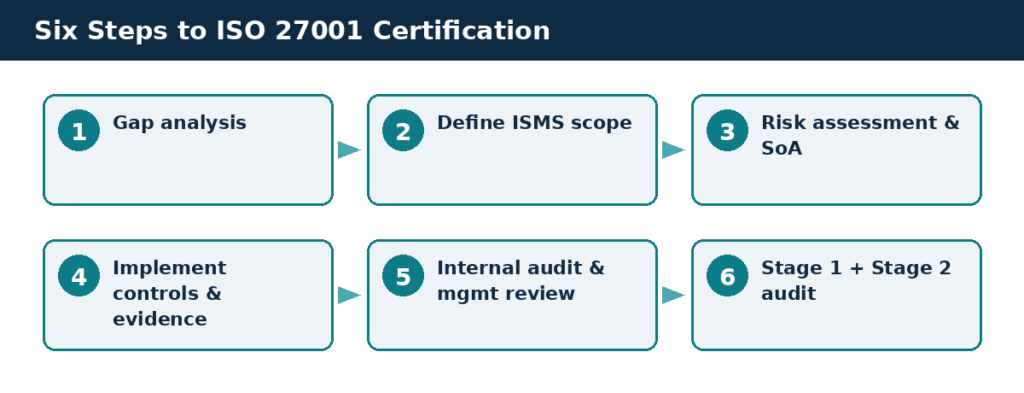
1. Gap analysis
Compare your current security posture against the standard’s clauses and the 93 Annex A controls. The output should be a prioritized remediation register, not just a percentage score.
2. Define the ISMS scope
Decide which entities, locations, systems, and services the certificate covers. UAE groups with mainland and free-zone entities need to decide early whether the scope covers one legal entity or several — this affects contracts, evidence collection, and audit cost.
3. Risk assessment and treatment
Identify information assets, assess risks against them, and select controls from Annex A (plus any additional controls you need). The Statement of Applicability (SoA) — the document justifying every included and excluded control — is the single most scrutinized artifact in the audit.
4. Implement controls and documentation
Policies, procedures, and technical controls get deployed and, critically, evidenced. Auditors want records: access reviews performed, incidents logged, awareness training completed, supplier assessments done.
5. Internal audit and management review
The standard requires you to audit your own ISMS and hold a documented management review before the certification body arrives. Skipping depth here is the most common cause of Stage 1 findings.
6. Certification audit (Stage 1 + Stage 2)
Stage 1 reviews your documentation and readiness. Stage 2 tests whether the ISMS actually operates. Pass both and you receive a certificate valid for three years, with surveillance audits in years one and two.
How Long Does ISO 27001 Certification Take?
For most small and mid-sized UAE organizations, plan for four to eight months from gap analysis to Stage 2, depending on scope size and how much documentation already exists. Larger or multi-entity scopes take longer. Certification bodies book weeks in advance, so the audit date should be fixed near the start of the project, not the end.
What Does It Cost?
Cost splits into three parts: internal effort, consulting support, and certification body fees. All three scale with scope size and organizational complexity, so any specific figure quoted before scoping is a guess. A scoped gap analysis is the only reliable way to produce a real budget — which is why Cybersecurity MEA structures engagements assessment-first.
Common Mistakes UAE Organizations Make
Buying a document toolkit and calling it an ISMS. Auditors test operation, not paperwork. Templated policies with no operating evidence fail Stage 2.
Scoping the whole group at once. A first certification covering every subsidiary multiplies evidence collection. Most groups certify the core operating entity first, then extend.
Treating the SoA as a formality. Excluding controls without defensible justification is a standard audit finding.
Ignoring the overlap with local frameworks. If NESA/UAE IA or PDPL also applies to you, map controls once across all frameworks instead of running parallel compliance projects.
People Also Ask
Is ISO 27001 certification mandatory in the UAE? No. It is voluntary, but it is frequently a contractual requirement in enterprise and government procurement, and it substantially covers the “appropriate technical and organizational measures” the UAE PDPL expects.
What is the difference between ISO 27001 compliance and certification? Compliance means you operate in line with the standard; certification means an accredited certification body has audited and confirmed it. Buyers generally only accept certification.
Does ISO 27001:2022 replace the 2013 version? Yes. The 2022 revision restructured Annex A into 93 controls across four themes, and the transition window for older certificates has closed — new certifications are issued against ISO 27001:2022.
Can a small business get ISO 27001 certified? Yes. The standard scales with scope. A focused scope with clean evidence is easier to certify than a sprawling one with gaps.
FAQ
Q: Does Cybersecurity MEA issue the certificate?
A: No consultancy does — certificates come from accredited certification bodies. Cybersecurity MEA prepares you for the audit: gap analysis, risk assessment, documentation, internal audit, and remediation support through its consulting and advisory services.
Q: What happens after certification?
A: Annual surveillance audits in years one and two, recertification in year three, and continuous evidence collection in between. Budget for maintenance, not just the project.
Q: We already follow NIST CSF. Do we start over for ISO 27001?
A: No. The frameworks overlap significantly; a mapping exercise typically carries most NIST-aligned controls straight into the SoA.
Ready to scope your certification path? Talk to Cybersecurity MEA about a gap analysis for your organization.