
The UAE Personal Data Protection Law (Federal Decree-Law No. 45 of 2021, the “PDPL”) is the country’s first federal data protection law, and most UAE businesses that handle personal data fall under it. If your organization collects customer, employee, or supplier data — which is effectively every organization — PDPL compliance is an operational requirement, not a legal abstraction. This guide covers who the law applies to, what it demands, and a practical order of operations for getting compliant.
Key Takeaways
- The PDPL applies to organizations processing personal data of individuals in the UAE, with carve-outs including free zones that operate their own data protection regimes (such as DIFC and ADGM) and certain government and regulated-sector data.
- Processing requires a legal basis; consent is the default and must be specific, informed, and revocable.
- Data subjects hold rights — access, correction, deletion, objection, portability — and you need a working process to answer them.
- Breaches that threaten privacy must be reported to the UAE Data Office; your incident response plan must include this step.
- Security controls, not paperwork alone, demonstrate compliance — which is where PDPL work overlaps with ISO 27001 and broader security programs.
Who Does the PDPL Apply To?
The law covers controllers and processors handling personal data of data subjects inside the UAE — whether the organization itself is in the UAE or processes UAE residents’ data from abroad. Financial free zones with their own data protection laws (DIFC, ADGM) apply their own regimes instead, and certain categories such as government data and data regulated by sector authorities sit outside the PDPL’s scope. If your group spans mainland and free-zone entities, expect to comply with more than one regime at once — the frameworks are similar in spirit but differ in detail.
What the Law Requires
A legal basis for every processing activity
Consent is the primary basis, and the bar is high: it must be clear, specific to the purpose, and as easy to withdraw as it was to give. The law also recognizes other bases, including processing necessary for contracts and legal obligations. The practical implication: you need a record of what you process, why, and under which basis — a processing inventory.
Transparency and data subject rights
Individuals can ask what you hold about them, demand correction or deletion, object to certain processing, and request their data in a portable format. Most UAE organizations fail here first, not from bad faith, but because no internal owner, inbox, or deadline exists for these requests.
Security of processing
Controllers and processors must apply appropriate technical and organizational measures — encryption, access control, monitoring, and vendor oversight. This is the clause that turns PDPL into a security project rather than a legal memo.
Breach notification
Personal data breaches that pose a risk to privacy must be notified to the UAE Data Office, and affected individuals informed where the risk is serious. Your incident response runbook needs this decision path built in — during an incident is the wrong time to discover the requirement.
Cross-border transfers
Transfers outside the UAE are permitted to jurisdictions with adequate protection or under appropriate safeguards such as contractual clauses or explicit consent. Cloud architecture decisions — where your SaaS vendors host UAE customer data — are PDPL decisions.
A Practical Compliance Sequence
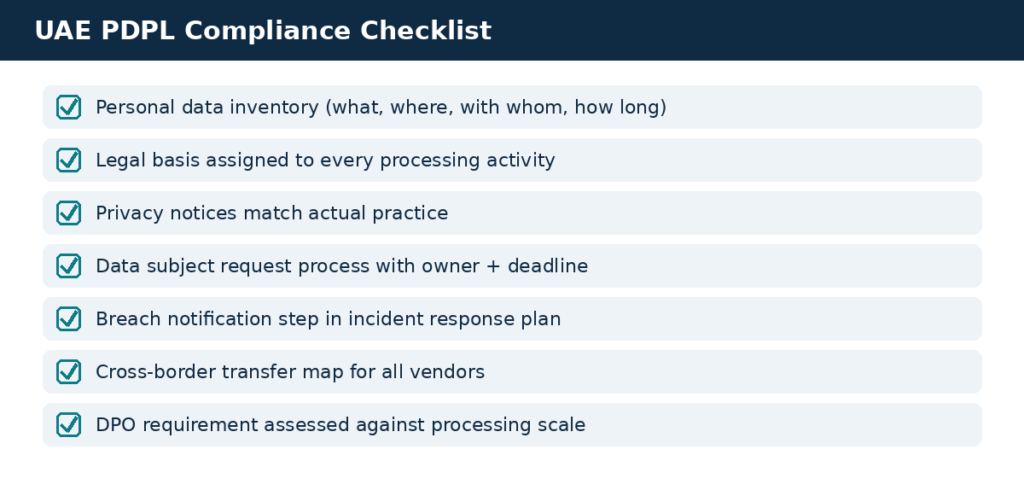
- Build a personal data inventory. What data, from whom, stored where, shared with which vendors, retained how long.
- Assign a legal basis to each processing activity and fix the gaps (usually consent capture and records).
- Rewrite privacy notices to match what you actually do.
- Stand up a data subject request (DSR) process with an owner and a deadline.
- Add PDPL breach notification to your incident response plan and test it in a tabletop exercise.
- Review cross-border flows — map where every vendor processes UAE personal data.
- Assess whether you need a Data Protection Officer based on the scale and sensitivity of your processing.
PDPL and Your Wider Compliance Stack
Most UAE enterprises face the PDPL alongside sector rules and frameworks like ISO 27001 or NESA/UAE IA. Running these as separate projects triples the work. A unified control mapping — one register showing how each control satisfies each framework — is the approach Cybersecurity MEA’s advisory practice uses, and it also produces the evidence an auditor or regulator will ask for.
People Also Ask
Is the UAE PDPL the same as GDPR? No, but they are structurally similar: legal bases, data subject rights, breach notification, transfer rules. GDPR compliance gives you a strong head start, not automatic PDPL compliance.
Does the PDPL apply to companies in DIFC or ADGM? Those free zones operate their own data protection laws and regulators, which apply instead of the PDPL within the zone. Groups operating across zones and mainland typically must satisfy both regimes.
What are the penalties for PDPL non-compliance? The law provides for administrative penalties determined under its executive framework. Have counsel confirm the current penalty position — enforcement details have been developing since the law took effect.
Do we need a Data Protection Officer in the UAE? The PDPL requires a DPO in defined higher-risk circumstances, such as large-scale processing of sensitive data. Whether you cross that threshold should come out of your data inventory, not guesswork.
FAQ
Q: We’re a small business — does the PDPL really apply to us?
A: If you process personal data of people in the UAE and no exemption applies, yes. Obligations scale with the risk of your processing, but the baseline duties — legal basis, security, breach response — apply regardless of size.
Q: How does Cybersecurity MEA help with PDPL compliance?
A: Data inventory and mapping, gap assessment against the law’s requirements, security control implementation, breach-response planning, and unified mapping to ISO 27001 and other frameworks through its consulting and advisory services. Legal interpretation stays with your counsel; we build and evidence the operational controls.
Q: Where do we start if we have nothing?
A: The data inventory. Every other obligation — bases, notices, transfers, DPO — depends on knowing what you process.
Need a PDPL gap assessment? Contact Cybersecurity MEA to scope one for your organization.