The UAE Information Assurance (IA) Standard — still widely called “NESA compliance” after the authority that issued it — is the national cybersecurity baseline for UAE government entities and operators of critical infrastructure. If your organization runs systems in sectors like energy, telecom, finance, healthcare, or transport, or supplies such organizations, the IA Standard shapes what your customers demand from you contractually. Here is what the standard contains, who it binds, and how to approach compliance without drowning in controls.
Key Takeaways
- The UAE IA Standard was issued by the National Electronic Security Authority (NESA); its requirements continue under the UAE’s national cybersecurity framework, and the market still calls it “NESA compliance.”
- It applies primarily to government entities and critical national infrastructure sectors — and cascades to their suppliers through contracts.
- Controls are split into management and technical families and carry implementation priorities (P1–P4), so sequencing is built into the standard.
- Compliance is evidence-based: risk assessment, implemented controls, and audit trails — not a one-off questionnaire.
- The IA Standard overlaps substantially with ISO 27001, so a unified control mapping prevents duplicate compliance work.
What Is the UAE IA Standard?
The IA Standard defines a comprehensive set of security controls covering governance, risk management, awareness, access control, communications security, incident management, and business continuity. Controls are organized into management families (strategy, governance, risk, awareness, compliance) and technical families (asset management, access control, operations, communications, incident response, continuity).
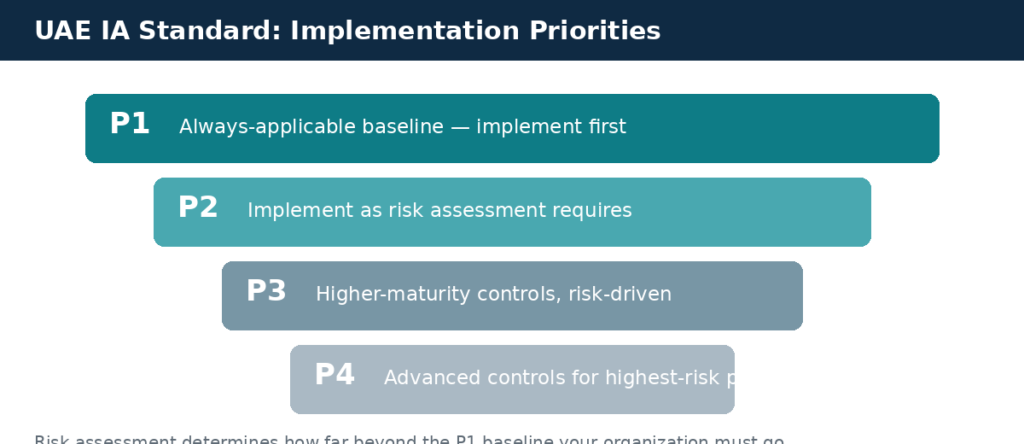
Two design features matter in practice. First, every control carries a priority rating from P1 to P4: P1 controls are the always-applicable baseline that entities are expected to implement first, while higher-numbered priorities phase in based on risk. Second, the standard is risk-driven — your risk assessment determines how far beyond the baseline you must go. That makes the risk assessment the anchor document of the entire program, exactly as with ISO 27001.
Who Must Comply?
Three groups, in decreasing order of directness:
- UAE federal government entities — bound directly.
- Critical infrastructure operators in designated sectors (energy, water, telecommunications, finance, health, transport, and similar) — bound through sector regulators and national directives.
- Vendors and service providers to both groups — bound contractually. This is the group most private UAE companies belong to without realizing it: if you supply software, cloud services, or operational support to a government or CNI customer, IA Standard clauses appear in your contracts and security questionnaires.
If you are unsure whether the standard applies to you, your contracts are the fastest answer — search them for information assurance and audit-rights clauses.
How NESA/UAE IA Compliance Actually Works
Step 1: Scope and asset identification
Define which systems process government or critical-infrastructure data. Over-scoping is expensive; under-scoping fails audits.
Step 2: Risk assessment
A documented, repeatable methodology assessing threats against the in-scope assets. The output drives which priority tiers of controls you must implement beyond the P1 baseline.
Step 3: Control implementation by priority
Implement P1 controls first, then work upward as your risk profile requires. The priority structure is effectively a built-in roadmap — use it rather than attempting all controls simultaneously.
Step 4: Evidence and audit readiness
Like every serious framework, the IA Standard is judged on records: access reviews, incident logs, training completion, continuity test results. Entities report compliance and undergo assessment; suppliers get audited by their customers.
NESA vs ISO 27001: Do You Need Both?
They serve different masters — the IA Standard satisfies UAE national requirements; ISO 27001 satisfies international customers and partners — but their control sets overlap heavily. Organizations that map both frameworks into a single control register implement once and report twice. Running them as separate projects roughly doubles the documentation burden for the same security outcome. This unified-mapping approach is central to how Cybersecurity MEA structures compliance engagements.
People Also Ask
Is NESA compliance mandatory in the UAE? For federal government entities and designated critical infrastructure operators, yes. For private companies, it becomes mandatory contractually when you serve those customers.
Does NESA still exist? The authority’s functions have been absorbed into the UAE’s national cybersecurity structure over time, but the IA Standard’s requirements and the market shorthand “NESA compliance” both remain in active use. Verify the current authority name in any formal submission.
How long does NESA/UAE IA compliance take? It depends on scope, current maturity, and how many priority tiers your risk profile activates. A gap assessment against the P1 baseline is the fastest way to get a real timeline — generic estimates are not meaningful.
What happens if we’re non-compliant? For directly regulated entities, consequences flow through the national framework and sector regulators. For suppliers, the practical consequence is losing contracts and failing customer audits.
FAQ
Q: We’re ISO 27001 certified. How much of NESA/UAE IA does that cover?
A: A substantial share of the control intent overlaps, but the IA Standard includes UAE-specific requirements and its own priority structure. A mapping exercise identifies the true delta — usually far smaller than starting from zero.
Q: Can Cybersecurity MEA run the whole program?
A: The consulting and advisory practice covers scoping, risk assessment, control implementation planning, and audit-readiness evidence — aligned with the standard’s P1–P4 sequencing and mapped to any other frameworks you carry.
Q: We only sell to one government customer. Is there a lighter path?
A: Scope the program to the systems that touch that customer’s data and contracts. The priority tiers let you meet the baseline without gold-plating systems that are out of scope.
Facing an IA Standard clause in a contract or tender? Contact Cybersecurity MEA for a scoped gap assessment.