Operational technology (OT) — the control systems running plants, pipelines, utilities, and buildings — cannot be secured with an IT playbook. The priorities invert: IT protects data confidentiality first; OT protects availability and physical safety first. Applying IT habits like aggressive patching or endpoint agents to a live control system can cause the very outage you’re defending against. This is why IEC 62443, the international standard series for industrial automation and control system (IACS) security, exists — and why it anchors OT security programs across the Gulf’s energy, utilities, and manufacturing sectors.
Key Takeaways
- IT and OT security optimize for different things: confidentiality-integrity-availability in IT, availability-integrity-safety in OT.
- Standard IT controls (patching cycles, scanning, endpoint agents, forced reboots) can disrupt or damage OT processes if applied blindly.
- IEC 62443 structures OT security through zones and conduits, security levels (SL1–SL4), and role-specific requirements for asset owners, integrators, and product suppliers.
- Segmentation between IT and OT networks is the single highest-leverage OT control for most industrial operators.
- Cybersecurity MEA leads with OT/ICS security regionally — see the services overview and the OT security whitepaper on the homepage.
Why IT Security Playbooks Fail in OT Environments
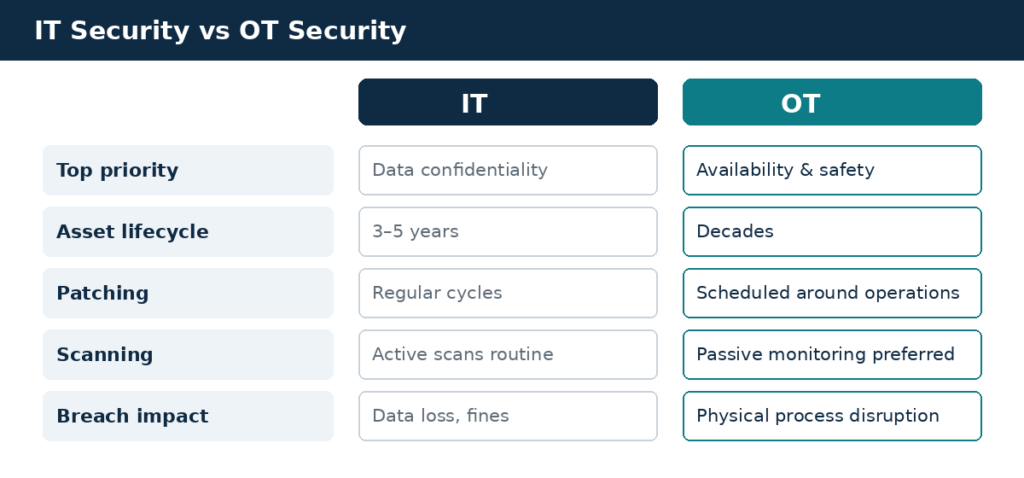
Four structural differences drive the failure:
Lifecycles. IT hardware refreshes in roughly three to five years; industrial control systems run for decades. OT estates legitimately contain operating systems and protocols that IT policy would classify as unacceptable — and that cannot simply be upgraded without process shutdowns.
Downtime tolerance. An IT server reboot is maintenance; an unplanned OT stop can mean lost production, safety incidents, or environmental damage. “Patch Tuesday” has no direct OT equivalent — remediation must be scheduled around plant turnarounds or mitigated with compensating controls.
Protocols and visibility. OT speaks Modbus, DNP3, OPC, and vendor-proprietary protocols that standard security tooling doesn’t parse. Active scanning that is harmless in IT can crash sensitive controllers; OT monitoring must usually be passive.
Consequence of compromise. IT breaches leak data. OT compromises manipulate physical processes — valves, breakers, turbines. The risk conversation shifts from privacy and fines to safety and national infrastructure, which is exactly why Gulf regulators treat critical infrastructure security as a national-level concern.
What IEC 62443 Actually Provides
IEC 62443 is a series of standards, not a single document, and three of its concepts do most of the practical work:
Zones and conduits
You partition the environment into zones of assets with similar criticality, and define conduits — the controlled communication paths between zones. This formalizes the most important OT control: segmentation. A corporate laptop should never have a direct network path to a controller.
Security levels (SL1–SL4)
Each zone gets a target security level based on the threat it must resist — from SL1 (protection against casual misuse) up to SL4 (protection against sophisticated, well-resourced attackers). Security levels turn “be more secure” into an engineering requirement per zone, which plants can actually implement and audit.
Role-based requirements
The series assigns distinct requirements to asset owners (operators), system integrators, and product suppliers. This matters commercially in the Gulf, where large EPC-driven projects involve all three roles: security requirements can be written into procurement and handover instead of being retrofitted after commissioning.
A Practical OT Security Sequence for Gulf Operators
- Asset inventory first. You cannot protect controllers you don’t know exist. Passive discovery avoids disrupting the process.
- Segment IT from OT. Establish the zone-and-conduit model with firewalls or data diodes at the boundary; kill flat networks.
- Control remote access. Vendor remote maintenance is the most common OT intrusion path — broker it through monitored, time-limited jump hosts.
- Add passive OT monitoring. Detect anomalies in industrial protocols without touching the process.
- Plan incident response for OT specifically. An OT incident plan that says “isolate the machine” fails when the machine is a running plant; response must be process-aware, engineered with operations, and rehearsed.
- Assign IEC 62443 security levels to zones and remediate to target, scheduled around operational windows.
OT Security and UAE Regulatory Pressure
Critical infrastructure operators in the UAE sit under national cybersecurity requirements (the UAE IA Standard lineage) as well as sector regulation, and OT is squarely in scope. For operators, the practical path is one control framework: IEC 62443 for the engineering layer, mapped upward to national requirements — the unified-mapping approach Cybersecurity MEA’s advisory practice applies across frameworks.
People Also Ask
What is the difference between OT and ICS? OT is the umbrella term for hardware and software controlling physical processes; ICS (industrial control systems) is the major subset that includes SCADA, DCS, and PLC-based systems. In security practice the terms are used near-interchangeably.
Is IEC 62443 mandatory? It is an international standard, not a law — but regulators and asset owners across the Gulf increasingly reference it contractually, and it is the de facto benchmark for industrial security programs.
Can we just air-gap our OT network? True air gaps are rare in practice — historians, remote maintenance, and business reporting all create connections. Assume connectivity exists and engineer the conduits, rather than trusting an air gap that quietly eroded years ago.
Does antivirus work on OT systems? Traditional agents often aren’t supported or safe on control hardware. OT endpoint protection relies more on allow-listing, network monitoring, and strict change control than on signature scanning.
FAQ
Q: Where should an operator with no OT security program start?
A: Asset inventory and IT/OT segmentation — in that order. Everything else in IEC 62443 depends on knowing the estate and controlling the boundary.
Q: How does Cybersecurity MEA deliver OT security?
A: OT/ICS security is a core specialization — assessment, zone-and-conduit architecture, monitoring design, and incident response readiness for industrial environments, alongside the broader service portfolio.
Q: Our integrator says security is handled. Is it?
A: Ask for the zone model, target security levels, and the remote-access design in writing. IEC 62443’s role-based structure exists precisely so those artifacts can be demanded at handover.
Running industrial operations in the UAE or wider Gulf? Talk to Cybersecurity MEA about an OT security assessment.