Every organization that gets serious about detection faces the same fork: build an in-house security operations center (SOC), or buy managed detection and response (MDR). The honest answer depends on scale, talent access, and how much control you need — not on which option is fashionable. Here is the capability-by-capability comparison, the questions that actually decide it, and the hybrid model most mid-sized Gulf organizations end up choosing.
Key Takeaways
- MDR delivers 24/7 detection and response as a service; an in-house SOC delivers maximum control at maximum staffing cost.
- Around-the-clock coverage is the hidden decider: staffing even one seat 24/7/365 requires several analysts once shifts, leave, and attrition are counted.
- The regional cybersecurity talent market makes hiring and retaining OT-aware, cloud-aware analysts genuinely difficult — attrition risk belongs in the decision, not just salary cost.
- Hybrid models (external 24/7 monitoring + internal escalation and context) are the practical middle path for most mid-sized organizations.
- Cybersecurity MEA delivers SOC-as-a-Service built on Microsoft security tooling — see the services overview — with advisory support for organizations designing their own coverage model through consulting engagements.
What Each Model Actually Is
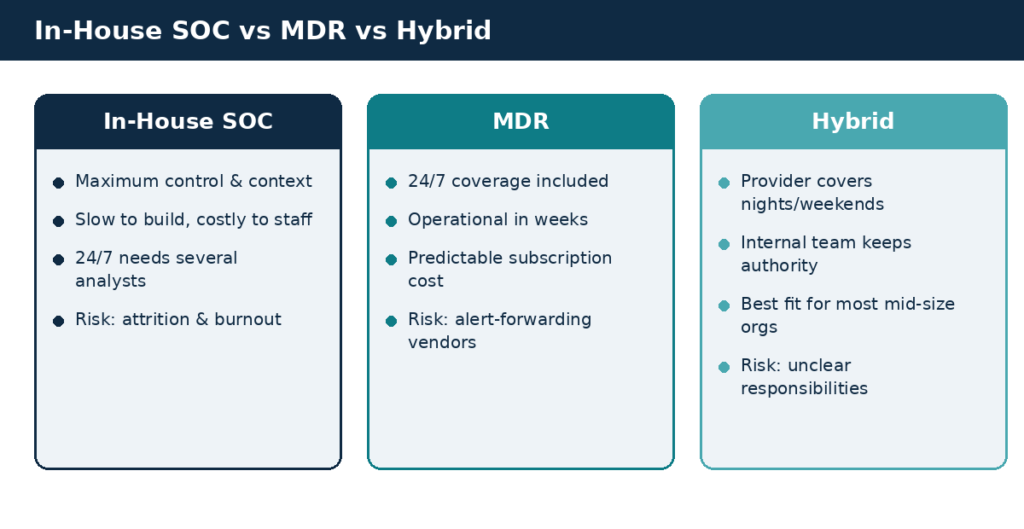
In-house SOC: your people, your tooling (SIEM, EDR/XDR, SOAR), your processes, your building or cloud. You own detection engineering, triage, response, and continuous improvement — and every hiring, training, and retention problem that comes with them.
MDR: a provider monitors your environment 24/7 through deployed or integrated tooling, triages alerts, hunts threats, and either responds directly or guides your team through containment. You keep ownership of the environment; the provider owns the watchstanding.
Hybrid / co-managed SOC: the provider covers monitoring and first-line response (especially nights and weekends); your internal team keeps business context, escalation authority, and remediation. The existing guide to cyber security services in Dubai covers where MDR sits in a wider service stack.
The Comparison That Matters
| Dimension | In-house SOC | MDR | Hybrid |
|---|---|---|---|
| Time to operational | Long — hiring, tooling, tuning | Short — onboarding weeks, not quarters | Medium |
| 24/7 coverage | Requires multiple analysts per seat | Included | Included via provider |
| Control & customization | Maximum | Bounded by provider’s service model | High for escalation/response |
| Business context | Deep | Must be transferred and maintained | Retained in-house |
| Cost structure | High fixed (salaries, tooling, training) | Predictable subscription | Mixed |
| Key risk | Attrition and burnout hollow out the team | Wrong provider = alert forwarding, not response | Blurred responsibilities if RACI is sloppy |
Specific cost figures depend on your headcount plan, tooling stack, and provider scope — any number quoted without that context is marketing, not analysis.
The Questions That Actually Decide It
- Can you staff nights and weekends — for years? Not “can we hire three analysts,” but can you keep a shift roster alive through attrition in a competitive Gulf talent market. If the honest answer is no, some form of external 24/7 coverage is not optional.
- How fast do you need to be operational? A regulatory finding, board mandate, or incident usually means months, not years. Building a SOC from zero rarely fits that clock.
- How unusual is your environment? Heavy OT, unusual applications, or strict data-residency needs argue for more in-house context — often the hybrid model — because that knowledge is expensive to transfer to a provider.
- Who holds response authority at 3 a.m.? Whatever model you pick, write down who may isolate a server, disable an account, or shut a plant process — before the first incident, not during it.
- What does your regulator or customer base expect? UAE regulated sectors increasingly expect demonstrable 24/7 detection. How you deliver it is your choice; that you deliver it often isn’t.
Red Flags When Evaluating MDR Providers
- Alert forwarding dressed as MDR. If the deliverable is “we send you the alerts,” that’s monitoring, not detection and response. Ask what the provider does before waking you.
- No regional presence or regulatory literacy. Providers unfamiliar with UAE frameworks slow down both response and compliance reporting — a point covered in the cybersecurity consulting UAE guide.
- Opaque scope on response. Contain? Remediate? Advise only? Get the response boundary in the contract.
- No tuning commitment. Detection quality decays without continuous tuning; ask how false-positive rates are managed over time.
People Also Ask
Is MDR cheaper than building a SOC? For most small and mid-sized organizations the fixed staffing cost of genuine 24/7 in-house coverage exceeds an MDR subscription, but the real comparison depends on your required coverage, tooling you already own, and salary market. Model both against your actual requirements.
What’s the difference between MDR and a managed SIEM? Managed SIEM operates the logging platform; MDR adds humans doing triage, hunting, and response on top of the telemetry. Managed SIEM without response is only half the loop.
Can MDR work with Microsoft Sentinel and Defender? Yes — Microsoft-stack MDR is a common model, using Sentinel as the SIEM and Defender/Entra signals as telemetry. It suits organizations already licensed for Microsoft security tooling.
Do we still need internal security staff with MDR? Yes. Someone internal must own the relationship, provide business context, and hold response authority. MDR replaces the night shift, not the security function.
FAQ
Q: How quickly can SOC-as-a-Service start delivering?
A: Onboarding is typically measured in weeks — connecting telemetry, agreeing escalation paths, and baselining the environment — versus the much longer runway of hiring and tuning an internal SOC.
Q: What does Cybersecurity MEA offer here?
A: SOC-as-a-Service and managed detection built on Microsoft security tooling, plus advisory support for organizations choosing between models — see the services overview and consulting practice.
Q: We already bought a SIEM. Does that decide it?
A: No — tooling ownership is compatible with all three models. A co-managed arrangement on your existing SIEM is often the least wasteful path.
Deciding between MDR and building your own team? Contact Cybersecurity MEA for a coverage-model assessment.