
A penetration test answers a question no scanner can: what would a skilled attacker actually achieve against your environment? For UAE organizations, pen testing is also a recurring compliance requirement — it appears in ISO 27001 programs, PDPL security-measure expectations, NESA/UAE IA control sets, and customer contracts. This guide explains the main test types, how to scope one properly, how often to test, and how to tell a real penetration test from an automated scan with a cover page.
Key Takeaways
- A penetration test is manual, goal-driven exploitation by skilled testers; a vulnerability scan is automated enumeration. Both are useful; only one proves impact.
- Test type follows asset type: web, mobile, network, API, cloud, and human (social engineering) each need different methods.
- Annual testing plus testing after significant changes is the baseline cadence most frameworks and UAE customers expect; higher-risk sectors test more often.
- Report quality is the product: risk-ranked findings with reproduction steps and remediation guidance — not a raw scanner export.
- Retesting after fixes closes the loop and produces the evidence auditors and customers ask for.
Pen Test vs Vulnerability Scan: The Difference That Matters
A vulnerability scan enumerates known weaknesses automatically and cheaply — run it continuously. A penetration test puts a human adversary against your defenses with a defined goal: access customer data, reach the internal network, take over a privileged account. The test proves exploitability and business impact, which is what boards, auditors, and regulators actually need to prioritize spending. Both existing Cybersecurity MEA guides — on cyber security services in Dubai and cybersecurity consulting for UAE enterprises — make the same point: raw scan output without risk ranking doesn’t move your posture.
The Six Main Types of Penetration Test
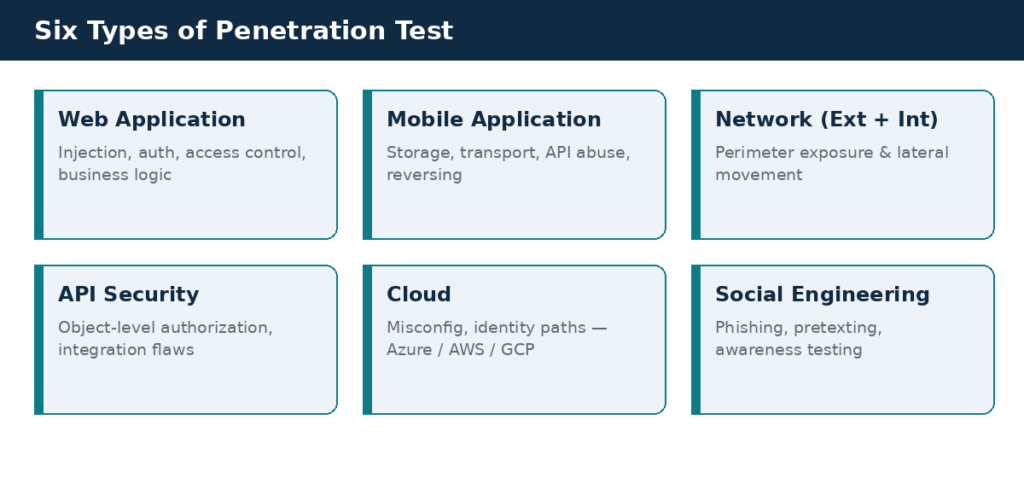
1. Web application testing
Manual testing of your web apps against classes of flaws like injection, broken authentication, and access-control failures (the OWASP Top 10 is the common baseline, not the ceiling). Business-logic abuse — the flaws scanners can’t see — is where experienced testers earn their fee.
2. Mobile application testing
iOS/Android app testing covering insecure storage, weak transport security, API abuse from the app’s perspective, and reverse-engineering resistance.
3. Network penetration testing
External: what can an internet attacker reach and exploit? Internal: starting from a foothold (a compromised laptop, a rogue device), how far can an attacker move toward domain or crown-jewel assets?
4. API security testing
APIs power mobile apps, integrations, and partner connections, and they fail differently from web UIs — broken object-level authorization being the classic. If your product exposes APIs, they need their own test scope.
5. Cloud penetration testing
Misconfigurations, identity and permission escalation paths, and exposed storage across Azure, AWS, or GCP — within each provider’s rules of engagement. Cloud tests focus on configuration and identity rather than infrastructure exploits.
6. Social engineering and phishing simulation
Tests the human layer: phishing campaigns, pretexting, and (where scoped) physical attempts. Findings feed awareness training rather than blame.
Red teaming sits above all of these: a covert, objective-driven exercise testing detection and response end-to-end. It’s valuable once your detection capability is mature enough to be worth testing — not as a first engagement.
How to Scope a Penetration Test Properly
- Define the goal, not just the targets. “Can an attacker reach customer records?” produces a better test than a bare IP list.
- Choose the knowledge model. Black box (no information) simulates an outsider; grey box (credentials, docs) buys more depth per testing day. Most organizations get better value from grey box.
- Set rules of engagement in writing. Testing windows, out-of-scope systems, emergency contacts, and data-handling rules — especially important where production systems serve regulated data.
- Demand a risk-ranked report. Findings with severity in business terms, reproduction steps, and concrete remediation — plus an executive summary a non-technical leader can act on.
- Book the retest. A fix without verification is a hope. Retesting converts the report into audit-grade evidence.
How Often Should UAE Organizations Test?
The working baseline: a full test annually, plus a scoped test after significant changes — new applications, major infrastructure moves, cloud migrations, or acquisitions. Regulated and high-exposure sectors (finance, government suppliers, critical infrastructure) commonly test more frequently or per release cycle. Framework drivers converge on the same rhythm: ISO 27001 expects technical compliance verification, the PDPL expects effective security measures, and NESA/UAE IA-driven contracts frequently mandate periodic testing outright.
People Also Ask
How long does a penetration test take? Typical engagements run one to a few weeks of active testing depending on scope, plus reporting. Timeline follows scope — a single web app is not a multi-site internal network.
Will a penetration test disrupt our systems? A professionally run test manages this through rules of engagement, testing windows, and communication channels. Genuinely fragile systems (including OT) are tested with adapted, lower-impact methods.
What certifications should pen testers hold? Recognized practical certifications (such as OSCP and equivalent hands-on credentials) plus documented methodology matter more than any single badge. Ask who will actually be on your engagement.
Is penetration testing legally required in the UAE? No single law mandates it universally, but it is effectively required through frameworks and contracts: ISO 27001 programs, PDPL security expectations, NESA/UAE IA-derived clauses, and enterprise customer audits.
FAQ
Q: What does Cybersecurity MEA’s testing practice cover? A: Web, mobile, network, API, cloud, wireless, secure code review, social engineering, and red/purple team exercises — the full test-and-evaluation range listed on the services overview, with scoping support through the consulting practice.
Q: Scan first or test first? A: Run vulnerability scanning continuously and fix the obvious findings; then use penetration testing to find what scanners can’t and to prove impact. Paying testers to rediscover unpatched CVEs is poor value.
Q: What should we prepare before testers start? A: Scope list, rules of engagement, emergency contacts, test accounts (for grey box), and stakeholder notification. Good preparation converts directly into more findings per testing day.
Planning this year’s test? Contact Cybersecurity MEA to scope it.